
Ran a workshop on DIST (Digital Impacts Schema and Taxonomy), the Green Web Foundation project, with Hannah Smith, the Green Web Foundation’s Director of Operations, at 9.30am on the first day of Green IO London 2026 (30 September to 1 October).
Organisations can measure the carbon footprint of their technology with growing confidence, but carbon is only one dimension. Water use, e-waste, biodiversity loss, supply chain conditions and the harms technology systems can cause to society and individuals are material too, and there is no consistent, open, structured way to report or share data about them alongside carbon. The workshop introduced DIST’s three-part tool suite, a taxonomy to catch the important impacts, a map of measurement methodologies, and a DIST.json schema for publishing impact data, and asked the room to help shape the standard.
Slides
-

Slide 1 text
DIST.GREENWEB.ORG Digital Impacts Schema & Taxonomy (DIST) Oliver Cronk, Founder, Cronk Advisory Hannah Smith, Director of Operations, Green Web Foundation
-
Slide 2 text
Who’s presenting today? Hannah Smith Director of Operations Green Web Foundation - a non-profit organisation working towards a fossil-free internet. Oliver Cronk Founder of Cronk Advisory and Architect Tomorrow Cronk Advisory: helps organisations get their arms around the impacts of their technology estates
-

-
Slide 4 text
Sustainability reporting is hard & digital technologies are complex. Putting the two together = 🤯
-
Slide 5 text
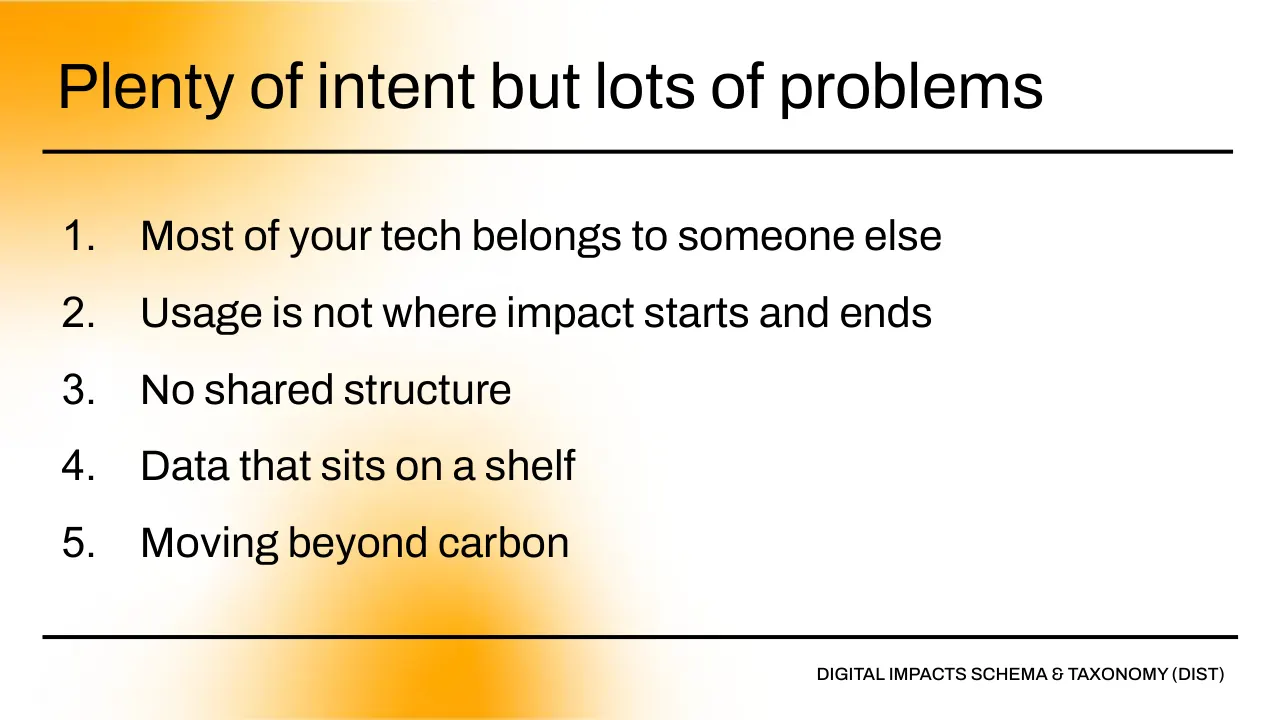
Plenty of intent but lots of problems 1. Most of your tech belongs to someone else 2. Usage is not where impact starts and ends 3. No shared structure 4. Data that sits on a shelf 5. Moving beyond carbon
-
Slide 6 text
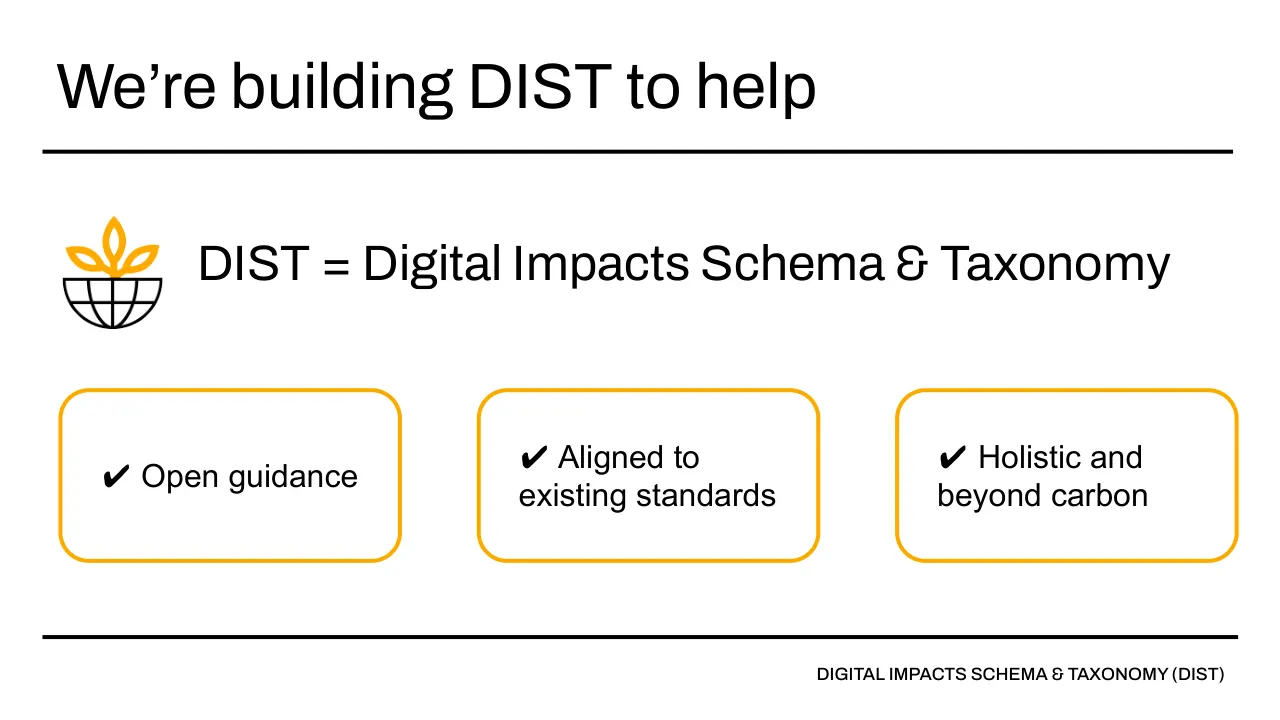
We’re building DIST to help DIST = Digital Impacts Schema & Taxonomy ✔ Open guidance ✔ Aligned to existing standards ✔ Holistic and beyond carbon
-
Slide 7 text
Poll / Question to the room: Does your org produce any internal or external-facing reporting on your digital emissions at the moment? POLL
-

Slide 8 text
How can you use and contribute to DIST?
-
Slide 9 text
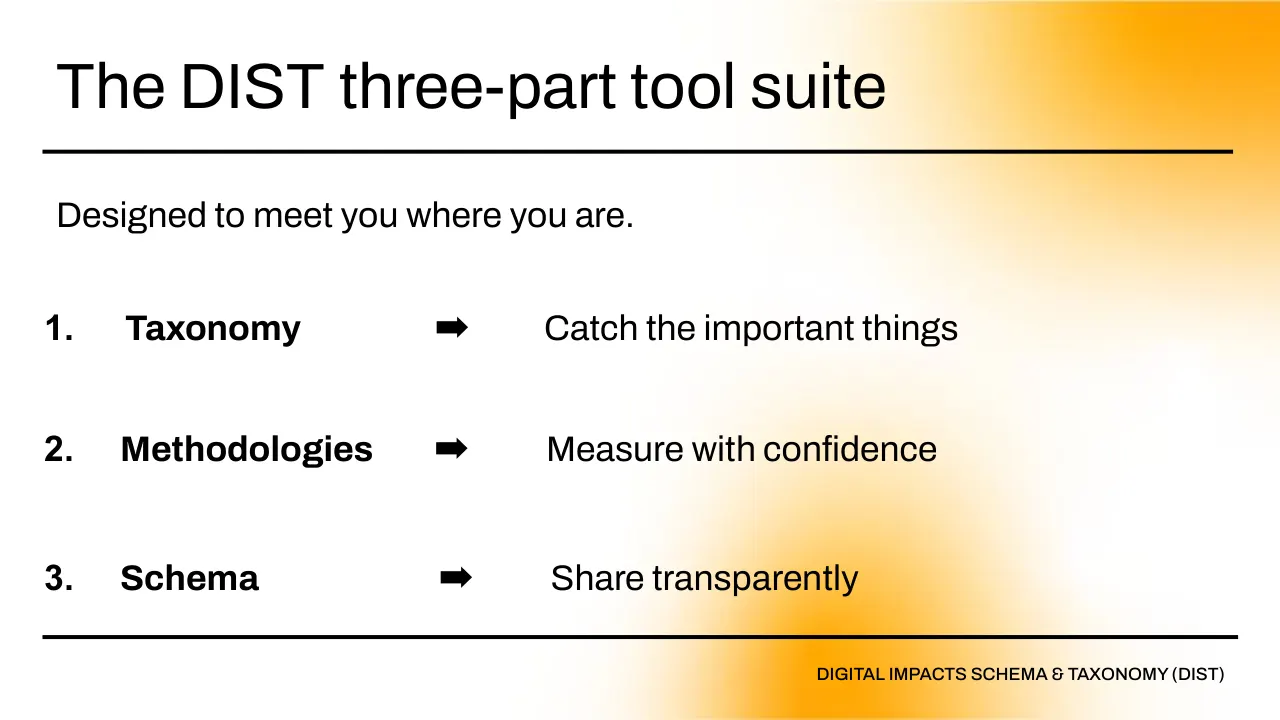
The DIST three-part tool suite 1. Taxonomy ➡ Catch the important things 2. Methodologies ➡ Measure with confidence 3. Schema ➡ Share transparently Designed to meet you where you are.
-
Slide 10 text
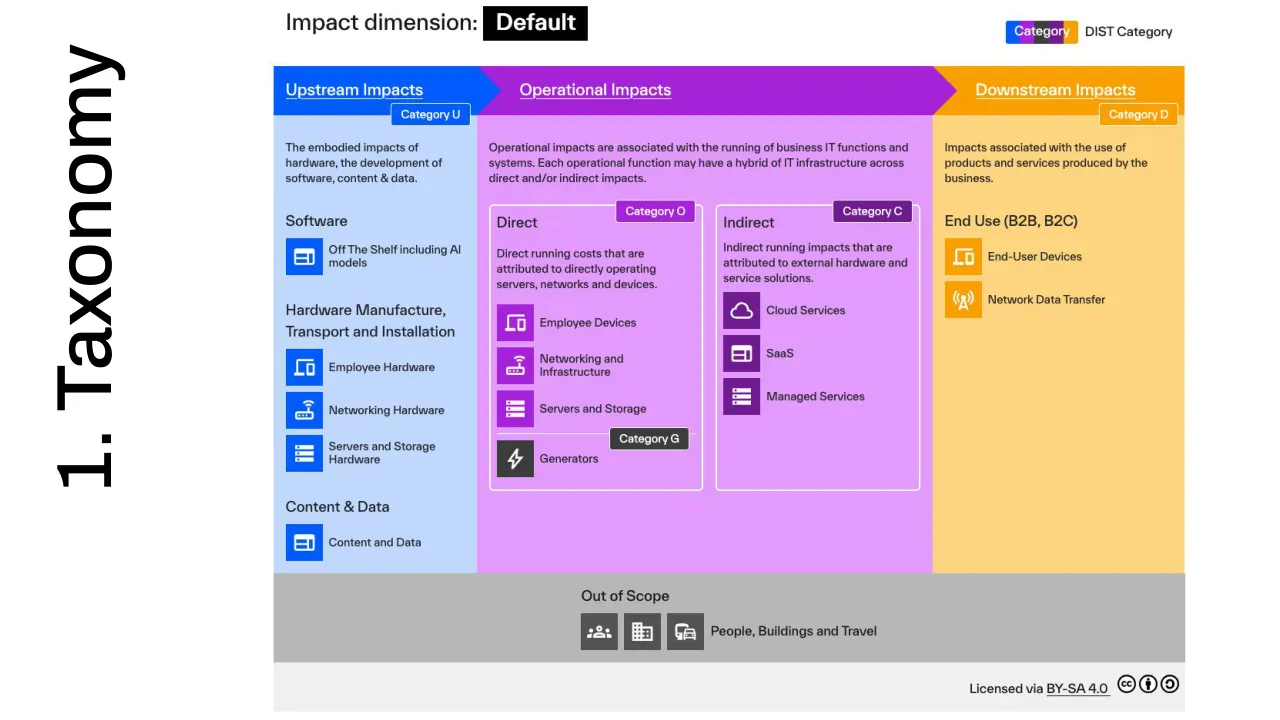
1. Taxonomy
-
Slide 11 text
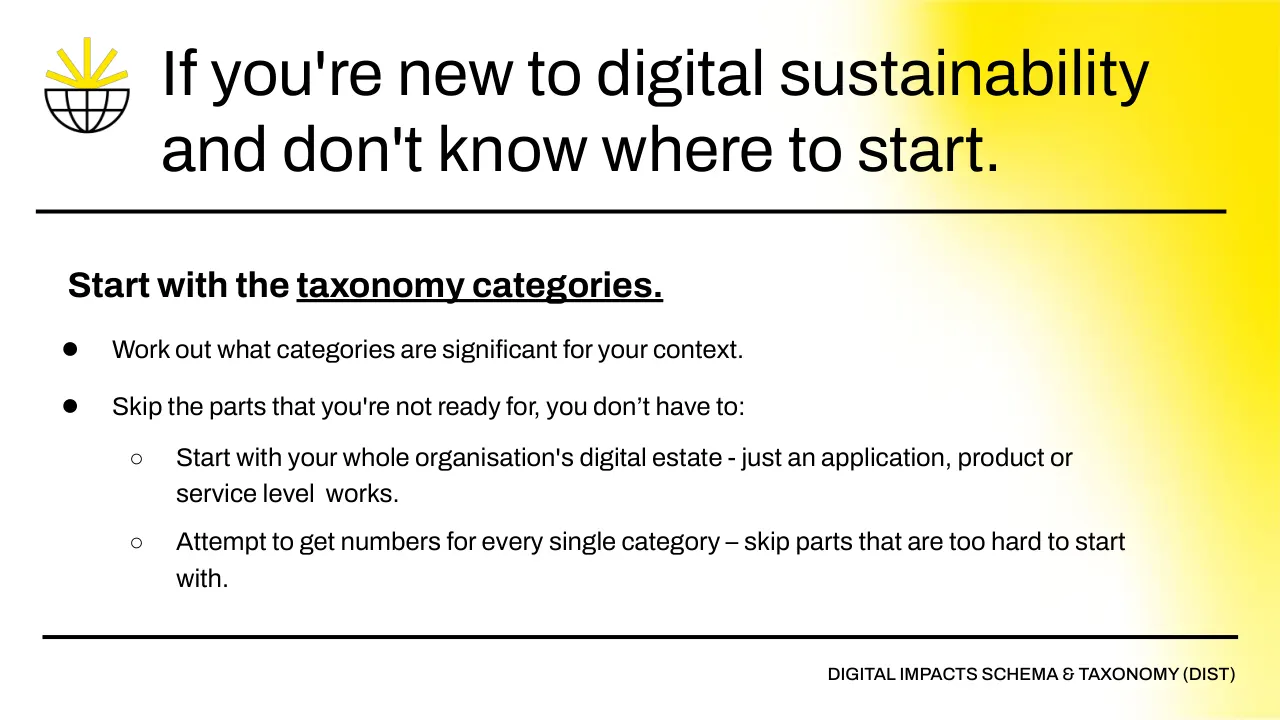
If you're new to digital sustainability and don't know where to start. Start with the taxonomy categories. ● Work out what categories are significant for your context. ● Skip the parts that you're not ready for, you don’t have to: ○ Start with your whole organisation's digital estate - just an application, product or service level works. ○ Attempt to get numbers for every single category – skip parts that are too hard to start with.
-
Slide 12 text
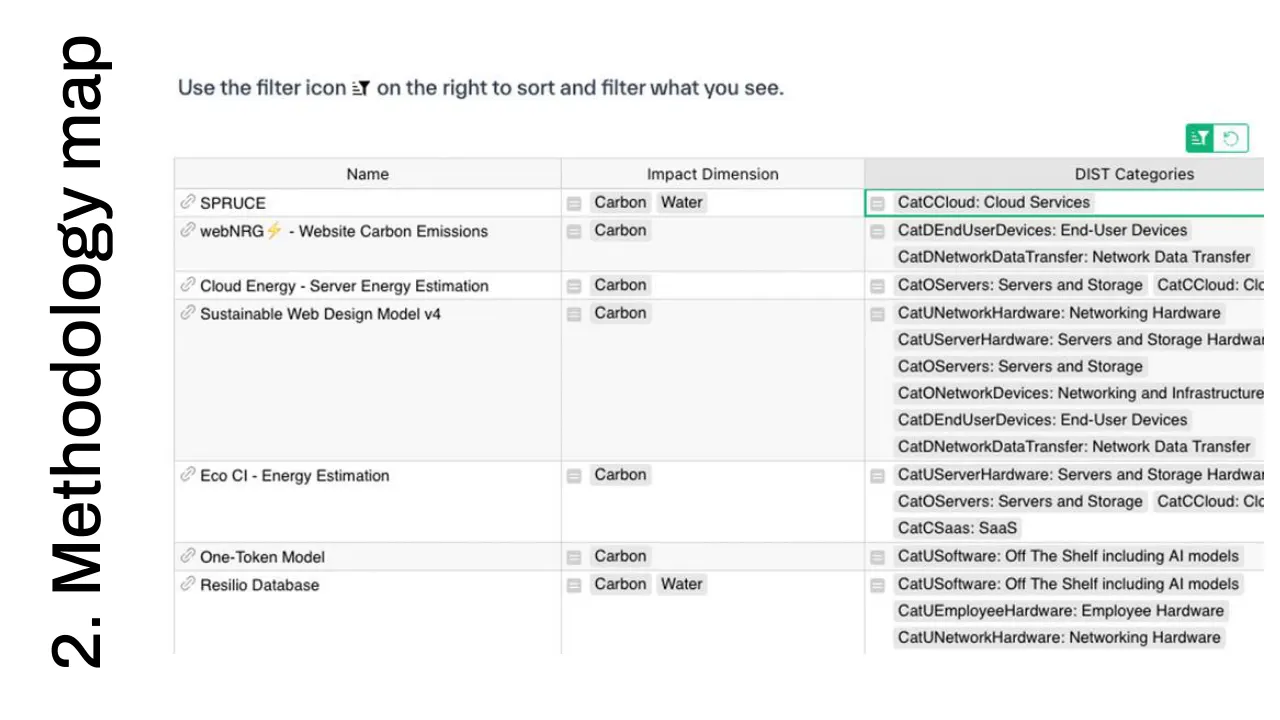
2. Methodology map
-
Slide 13 text
2. Methodologies – starting with carbon Find methods* to fill your measurement gaps. ● A curated list of measurement and estimation methods, mapped across every category of the taxonomy. ● Differentiate between open methods and commercial ones. * Think of methods as a broad term covering a range of approaches such as calculation procedures, formulas, datasets, estimation tools and resources - anything that helps you produce numbers for a taxonomy category.
-
Slide 14 text
You know the categories, but aren't sure how to work out the numbers. The methodology map will be your starting point. ● Soon you’ll be able to filter methods by category and other criteria. We’re working on the carbon list, and are looking for help.
-
Slide 15 text
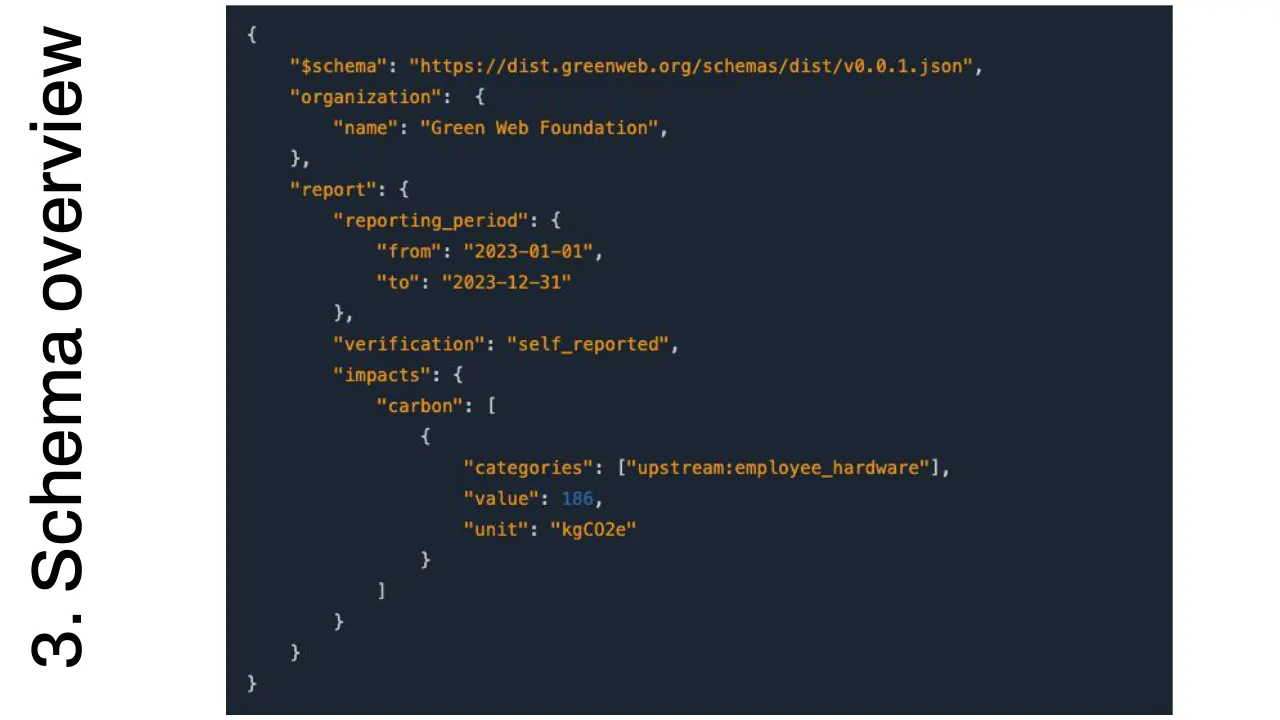
3. Schema overview
-
Slide 16 text
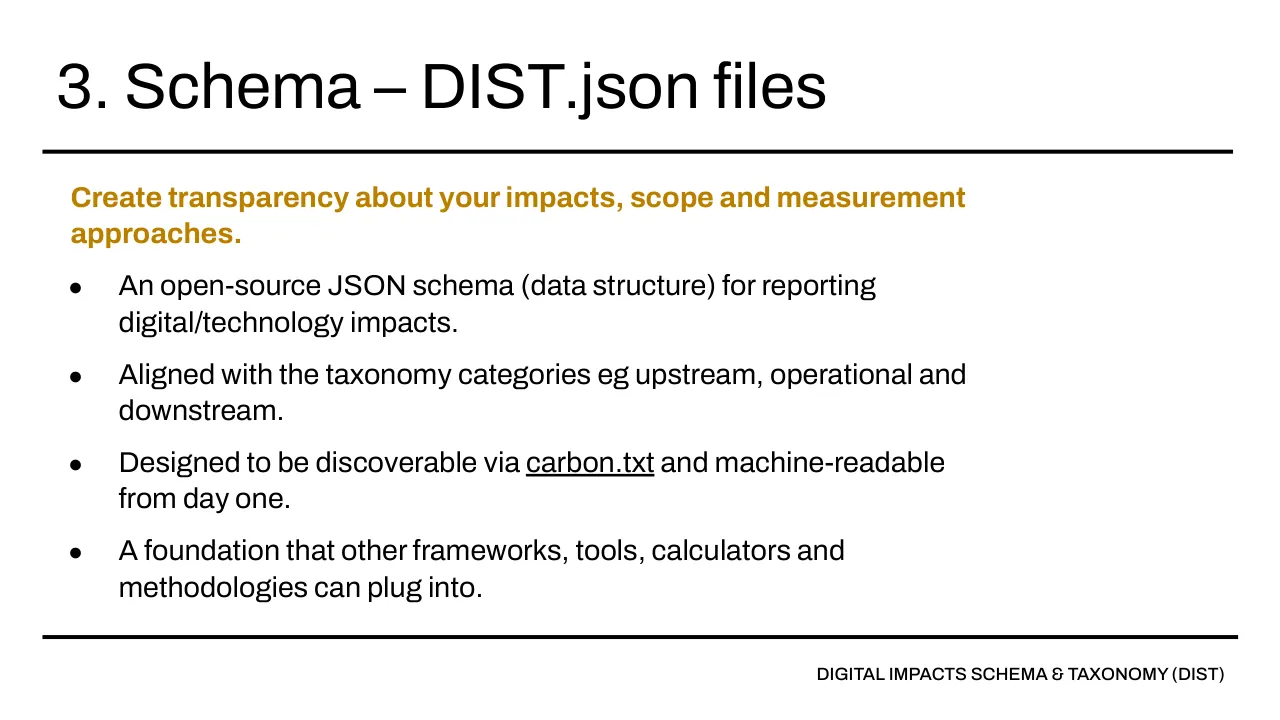
3. Schema – DIST.json files Create transparency about your impacts, scope and measurement approaches. ● An open-source JSON schema (data structure) for reporting digital/technology impacts. ● Aligned with the taxonomy categories eg upstream, operational and downstream. ● Designed to be discoverable via carbon.txt and machine-readable from day one. ● A foundation that other frameworks, tools, calculators and methodologies can plug into.
-
Slide 17 text
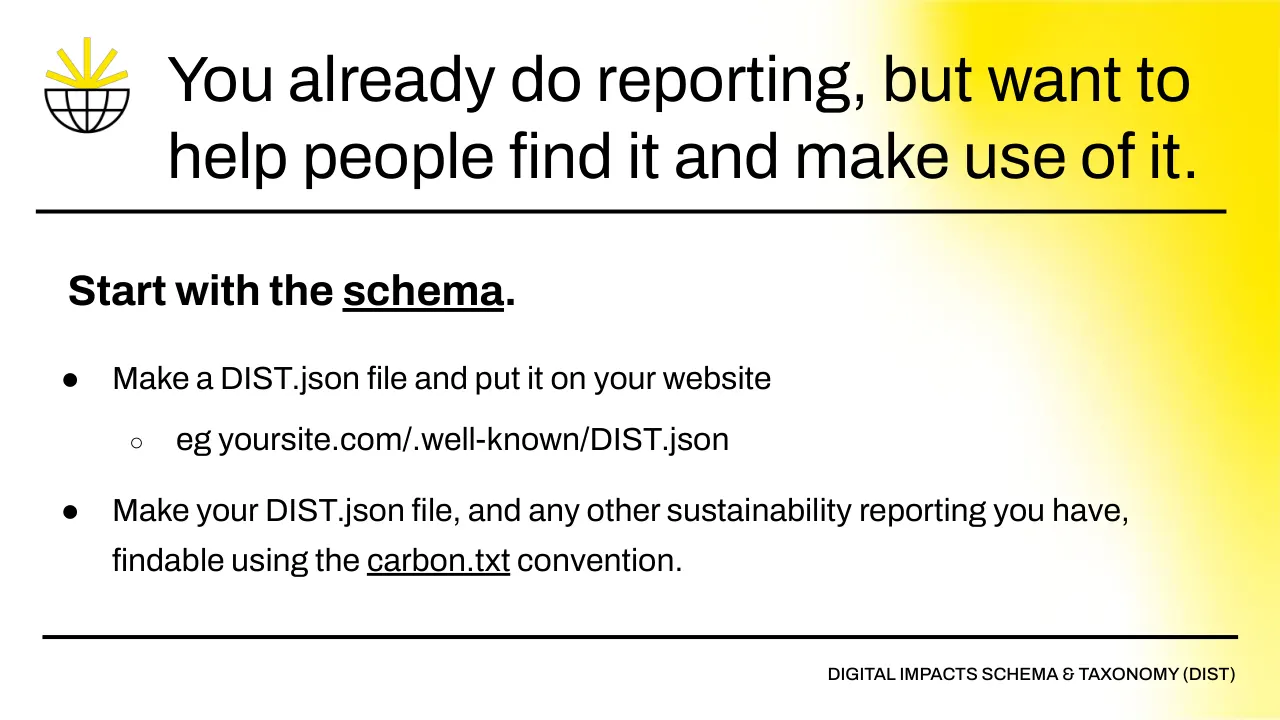
You already do reporting, but want to help people find it and make use of it. Start with the schema. ● Make a DIST.json file and put it on your website ○ eg yoursite.com/.well-known/DIST.json ● Make your DIST.json file, and any other sustainability reporting you have, findable using the carbon.txt convention.
-
Slide 18 text
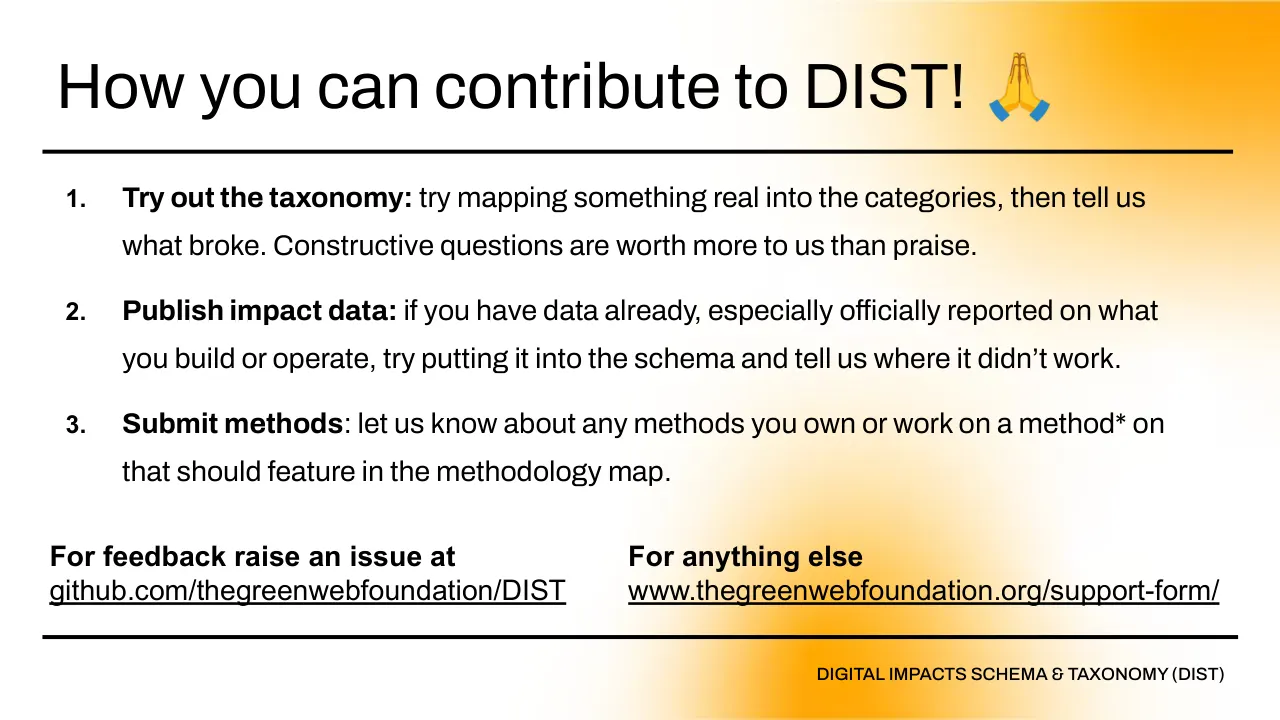
How you can contribute to DIST! 🙏 1. Try out the taxonomy: try mapping something real into the categories, then tell us what broke. Constructive questions are worth more to us than praise. 2. Publish impact data: if you have data already, especially officially reported on what you build or operate, try putting it into the schema and tell us where it didn’t work. 3. Submit methods: let us know about any methods you own or work on a method* on that should feature in the methodology map. For feedback raise an issue at github.com/thegreenwebfoundation/DIST For anything else www.thegreenwebfoundation.org/support-form/
-

Slide 19 text
POLL: What problems do you think this could solve in your supply chain? POLL
-
Slide 20 text
Thank you Questions and feedback welcomed