November 09, 2009
Filed Under (Open Source, Samba, Vista and Windows 7) by Ollie Cronk on 09-11-2009

Further to my blog posts involving vista (and the tweaks that can help make Vista/Windows 7 compatible with Samba) I came across a registry setting that needs to be changed to get offline files to work correctly:

“Set the following registry key on the Windows Vista client to prevent files from getting pulled down to the client again right after synchronizing changes to the server (due to Linux file systems having coarser timestamp resolution than Windows):

Create a DWORD value named RoundUpWriteTimeOnSync under the HKLM\Software\Microsoft\Windows\CurrentVersion\NetCache key (create the key if it does not exist) and set it to 1.” from the Storage Team at Microsoft’s Blog: http://blogs.technet.com/filecab/archive/2007/03/16/using-offline-files-with-samba-emc-servers-nas-devices.aspx


July 24, 2009
Filed Under (Life, Mountain Biking) by Ollie Cronk on 24-07-2009

Some Recent Tech Discoveries I thought I’d share:

The Good:

Windows 7 RC – writing the blog post from it – excellent OS (and that says a lot coming from me!)

Ubuntu 9.04 -What can I say – wow – is the OS market hotting up or what? Right when they said the Browser will be the O/S – we’ll we aren’t there yet (well not until Google’s Chrome OS anyway…)

Spotify – sure lots of people know about this one now but great streaming music service. Kind of like a commercial radio station where you get to choose the playlist. But native version for Linux would be nice (netbooks will make this kind of porting happen organically now I suspect??)

Bitly – specifically the Bit.ly Sidebar for your browser – very clever. You’ll notice I’m starting to use more bit.ly links in my blog posts but for Twitter they are essential.

The Bad:

ebox – Not a good move to just try and install this on a Ubuntu box (tried this at home) screwed lots of stuff up. Nice idea but if you want to try it out use a seperate box. It looks good and the concept is a great idea but I think its a bit too flawed for me right now (sorry ebox devs).

Denyhosts (prevents brute force attacks on SSH by adding IP addresses that repeatedly fail to login to a black list – in /etc/hosts.deny)  silently stopped working some time ago on my Ubuntu server (due to an upgrade of Python by the looks of things). Following the fix on this forum thread sorted the problem although I found the file you need to change is:  /usr/share/denyhosts/daemon-control-dist rather than the one mentioned.

The Ugly:

HMG Info Sec standards (or rather the OTT implementation of) - I probably can’t say any more or I’ll get burned in acid (its a long and painful story…!)

More posts to come. Enjoy the summer everyone. I intend to on a ride around Litchfield tomorrow – embedded Google Map to follow no doubt…!


May 17, 2009
Filed Under (Open Source, Technology, Web Development, Wireless) by Ollie Cronk on 17-05-2009

One of my projects at the moment is to look at our options for building SMS enabled web applications (specifically for us around our Zend Framework based apps). Both for data capture (Inbound) and as an alerting / notification system (Outbound).

Thought I’d pull together some of my thoughts and reference material [not exhaustive or complete yet] in case its of use to anyone else in a similar situation. But first I’d like to thank my good friend Jem who helped identify some different angles on this…

Research Material:

As always the first place to start is Google and Wikipedia – http://en.wikipedia.org/wiki/SMS and http://en.wikipedia.org/wiki/SMS_gateways

LinkedIn Q&A is a great reference – here are a few relevant threads that I came across (you’ll probably need a Linkedin.com account to get to these) there are lots more if you search around with SMS related keywords.

Implementation Options:

There are 2 main options – and as always its the struggle between D.I.Y and DRY (Don’t Repeat Yourself – or my version DRY-OFF – DRY or others [for f sake? I just wanted it to be OFF as it sounded better; anyway I'll shut up now!])

Roll your own

The Kannel FAQ covers this point quite well – http://www.kannel.org/faq.shtml#1.2

pros – complete control over messaging and ability to iron out any kinks in connectivity etc, potentially cheaper to run / only costs you what you use (rather than having to buy credits)

cons – more complex to setup in the first place, need to buy & setup some hardware somewhere etc

Useful article on Kannel on Ubuntu with PHP5: http://www.chipmunkninja.com/Setting-up-Configuring-and-Using-13@

Outsourced

Pros – ease of getting it up and running if the integration API (eg HTTP, XML/E-mail based) is easy to pick up

Cons  – my concern around these guys is how do you how good they are – will they disappear tomorrow? What gateways are they using, how reliable are their channels etc.

Guide to Gateways (US focused) but has some nice general considerations) http://www.developershome.com/sms/howToChooseSMSGateway.asp This site also has a really nice comparison table – which you could also use as a template for doing your own matrix/scoring comparisions of these services.

We will probably go with a combination of the 2 options – using our own system for the development of services (as we have greater control) and then making use of a partner once the message volumes go above what is finanically viable/scalable in house…

Once the technical bit is out of the way you then need to consider the usability and process flow around the app – eg if users are sending in data, queuing, acknowledging their submissions, correcting mistakes etc…

Hope to post more on this topic if I get the opportunity! If anyone has any insights or good resources on this topic then by all means please comment on this post!

Thanks


April 27, 2009
Filed Under (Linux, Open Source, Ubuntu) by Ollie Cronk on 27-04-2009

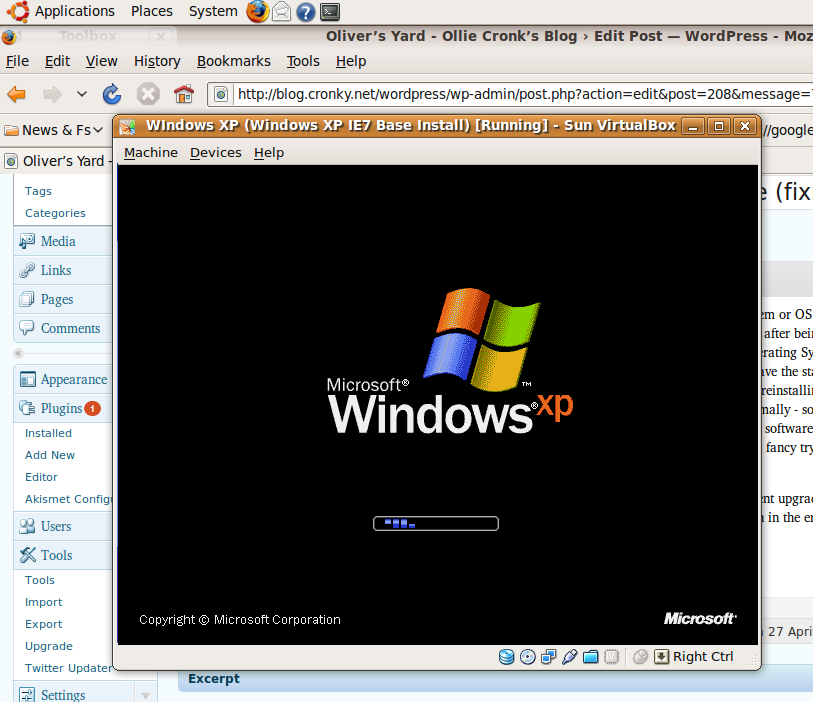
Screenshot of VirtualBox running XP under Ubuntu
Recently I’ve started using Virtualisation – for those who don’t know this is running an Operating System or OS for short (such as Windows) as an application (so you could think of it as running a computer within a computer). I’ve started doing this as I’ve got frustrated with Windows slowing down after being installed for a few months. This way I can run Linux which is very stable and performs consistantly as the main Operating System (or the “Host”) and then run various “Guest” OS installations – such as Windows. You can take snapshots or save the state of the Guest machines – which is ideal if you want to go back to how your Windows install used to be (but unlike reinstalling all your applications and settings are as they were).

Generally Windows runs at the same speed as it does normally – so long as you don’t run too much stuff on the Host OS at the same time – but of course there are limitation – eg Games or software that needs access to devices that can’t be provided via VirtualBox. And of course you could run the reverse setup – if you fancy trying Linux as a Guest OS but keeping the safety net of Windows as your main Operating System.

Anyway I’m posting this as I’ve been using VirtualBox on Ubuntu Linux to run Windows XP. On a recent upgrade from Ubuntu 8.10 to the latest version 9.04 VirtualBox failed to run. This was fixed by running the command given in the error message (its nice to get a very useful error message in software!)

The command I had to run was sudo /etc/init.d/vboxdrv setup

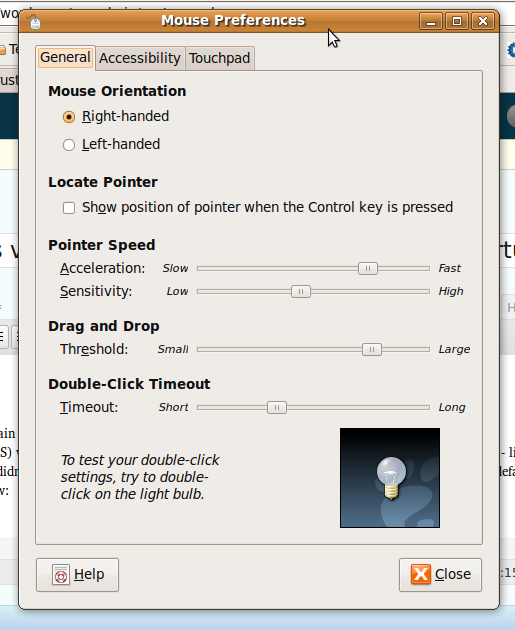
Once VirtualBox was working again I noticed that the Host key (which is the key used in different combinations to switch between the Host and the Guest OS) was not working. Instead it was flashing the Ubuntu desktop and pulsed some circles – like radar – from the cursor. At first I didn’t twig that it was simply the new mouse settings in the latest version of Ubuntu. By default it now seems the tickbox below in System->Preferences->Mouse for “Show position of pointer when the Control key is pressed” :

Mouse Settings in Ubuntu

Mouse Settings in Ubuntu

Hey presto – the host key works again! Hopefully this is helpful for anyone else confused by this one!

Also note the position of the sliders in the above screenshot for acceleration and sensitivity – I find these settings make the touchpad on my Vaio behave in a similar way to Windows (previously my mouse felt too sluggish).

I’m now actually using Windows less and less now at home (Evolution is a decent email client and of course Firefox offer pretty much the same browsing experience – apart from some differences with fonts, and OpenOffice allows for opening the odd Office attachment). The true acid test though is how much the wife moans as previously she’s never been happy without the familarity of Windows…! (But then it is still available in a couple of clicks).

I’m sure there will be more on my adventures of using Ubuntu on the desktop in due course – if I find time I’ll share anything I think others might find useful…


December 15, 2008
Filed Under (Open Source, Technology, Web Development) by Ollie Cronk on 15-12-2008

Have just upgraded to the latest and greatest Wordpress and was shocked as it has wowed me again in terms of user interface. The pace of improvement of this Open Source product is incredible. Just as I think wouldn’t it be good if… they’ve done it in the next release (and improved stability / fixed bugs).

They’ve introduced a turbo button which makes use of Google Gears (the offline/browser enchancement) and added more time saving shortcuts and a better post writing interface (particularly for re-using existing tags on new posts – this UI for tagging taxonomy might have to be borrowed on some of my projects…) Read their blog post here for more info on features (includes a video).

Below is the new dashboard – compare the below to Wordpress 2.5 that I upgraded to back in May 08

fireshot-capture-5-olivere28099s-yard-ollie-cronke28099s-blog-e280ba-add-new-post-e28094-wordpress-blog_cronky_net_wordpress_wp-admin_post-new_php

The new dashboard is below – it now has dragable “modules”

wordpress_wp-admin

Trouble is it now makes me want to upgrade the design of my blog – but I know I have way more important things to do with my time before I faff with that again!


November 14, 2008
Filed Under (Open Source, Web Development) by Ollie Cronk on 14-11-2008

Alfresco Logo I came across Alfresco a couple of years ago at the MySQL European Customer conference – at the time they were relatively new and didn’t look that relevant. I’ve kept one eye on them since and have recently had the opportunity at work to look at alternatives to Sharepoint. Alfresco is now looking very, very interesting in this respect.

Alfresco’s features cover:

Its not that often (although admitedly it is now getting more common) you find an Open Source product that is strong on features / usability and is technically strong. The reason I say it is technical strong is due to the way it embraces and leverages Open Standards and Open Source Java components (Such as Hibernate etc – which good PHP frameworks have borrowed heavily from recently).

One of Alfresco’s people writes an interesting blog on the Business/Politics of Open Source: http://news.cnet.com/openroad/

Another Interesting Alfresco blogger is John Newton: http://newton.typepad.com/content/ He has an article on CMIS (Content Management Interoperability Services) which sounds fantastic.

Look forward to learning (and blogging) more about Alfresco if I get the opportunity…


March 15, 2008
Filed Under (Open Source, PHP, Ubuntu, Web Development, Zend Framework) by Ollie Cronk on 15-03-2008