Archive for the ‘Web Development’ Category
August 27, 2010
Continuing in my series on professional development – see the previous article on documentation here (ok so there has been a bit of a pause and I am stretching things to call this a series – I had intended to post this some time ago!). This post concentrates on the benefits of using an Issue / Task / Bug Tracking Tool… Keeping track of development tasks and issues in a centralised system helps enormously. Living without task tracking for your issues is a lot like not having having source control for your code. A good task tracking system – such as Fogbugz or Countersoft Gemini helps keep track of what the team needs to do, allows issues to be delegated / reallocated to more appropriate team members and enables multiple lines of support (eg 1st line, 2nd line etc). It also allows transparency on tasks (allowing Jane who requested a new developer to check the issue tracker for progress rather than interupting the technical team) and (particularly for those of us that need to follow ISO9001 type standards) provides an Audit trail if used properly. Of course its not just about standing up an issue tracking tool – you need to agree on things like - what defines an High Severity issue over a medium severity one? What Service Level agreements do we have and how does the issue track tie to those (eg does selecting medium mean response within a day as opposed to high which requires a response within 1 hour for arguments sake). - What is the process from issue inception through to resolution (does a new change request issue go to Bob -or better Bob’s role “Change Manager” – who allocates it to someone to estimate and changes the status to pending estimation). - What level of documentation are you looking for in the comments associated with a case – is just referencing a source control commit enough (which is ok if your source control commits are verbose) or do you want a short explaination of what was done? Clearly if done right this can allow your team to scale and stop your developers getting bogged down with admin (make sure there is someone overseeing the issue tracker). It can also make it easier to seperate support work from new big development work (the former you can give to junior colleagues to help them get up to speed with support from more senior ones – preventing senior guys/girls from getting bored with smaller stuff). One other observation on this is that whilst you do need to be strict in order to implement these tools (eg ensuring that folks always use the tracker rather than continuing to email you all the time) you need to make sure they don’t become a barrier to communication between the technical team and its customers. One thing I like to do when involved in an operational issue is to cc the issue tracker in on an more detailed email explaining an issue – the customer gets a personalised response and the issue tracker captures the commentary (preventing time wasted by copying and pasting). Would love to hear others thoughts on their use of issue tracking systems and the pros / cons.
March 01, 2010
Here are some notes / interesting products/thoughts that were mentioned (apologies this is more of a set of notes for me than a proper blog post – if I get time I will refine this!) Started the day on a conference call back to the office so had to miss the keynote which was a shame as it was by quite an eccentric guy who Microsoft have hired (as a UX Architect Evangelist) largely about keeping thing simple and usability from what I gathered of the end of the talk. Day was very tough as a I had a late night catching up on various things to allow me to free up the Friday – its difficult sitting through talks when really tired! Met with several former colleagues from my last company (and former colleagues from my current company) so was a bit of a blast from the past at times. There appear to be a lot of development and interest around NoSQL / document based databases at the moment – definitely something to keep an eye on as it matures as a technology. RDBMS in the social networks age Database Graph Structures via advanced features of SQL, using SQL-99 and SQL-2003 functionality that certainly MySQL doesn’t have any many other DBs won’t have the 2003 extensions. Obviously using this kind of advanced functionality will have an impact on Database server load. This talk felt a bit like it was flying in the wind of most new thinking at the moment (although to be fair – this is partly what Lorenzo has now put on his website below) which is to keep your database tier minimally loaded as it’s the part that has most issues with vertical and horzontal scalability (keep most of the CPU load in the web app tier as its easier to add more nodes there). Slides available at: Legacy Code Talk by Ibuildings ctags.sourceforge.net BOUML bouml.free.fr (reverse engineering capabilities) phpcs – Codesniffer (part of PhpUnderControl) Thoughts for tackling older PHP4 based projects and code bases – get them in Source Control, start to apply Continous Integration type approaches. Suggestions made around CouchDB Web and mobile application monetisation models / Paypal X Paypal appear to be launching a new platform / API
Bit disappointed by this one as it was about PayPal’s API (https://www.x.com) rather than strategies for monetisation which is what the title lead me to believe. Web Services Best Practise Lorna (also from iBuildings) who gave this talk seems to have a bit of a sarcastic talking down to you type tone I found slightly annoying – maybe she gives training to newbies all the time or something. Or maybe I was just tired. She had some interesting things to say about Web Services design particularly towards the end of her talk. The talk was caveated as being a bit of “a rant” and it was exactly that in places – felt like she was having a go at everyone a lot of the time! Beers at the end sponsored by Facebook were a nice touch though, although I only had time to grab a quick one whilst chatting to Mark Schaschke from iBuildings and a couple of guys from my previous company. Think next year I will sit this one out to allow more developers to attend as think they will get more value out of it.
May 17, 2009
One of my projects at the moment is to look at our options for building SMS enabled web applications (specifically for us around our Zend Framework based apps). Both for data capture (Inbound) and as an alerting / notification system (Outbound). Thought I’d pull together some of my thoughts and reference material [not exhaustive or complete yet] in case its of use to anyone else in a similar situation. But first I’d like to thank my good friend Jem who helped identify some different angles on this… Research Material: As always the first place to start is Google and Wikipedia – http://en.wikipedia.org/wiki/SMS and http://en.wikipedia.org/wiki/SMS_gateways LinkedIn Q&A is a great reference – here are a few relevant threads that I came across (you’ll probably need a Linkedin.com account to get to these) there are lots more if you search around with SMS related keywords. Implementation Options: There are 2 main options – and as always its the struggle between D.I.Y and DRY (Don’t Repeat Yourself – or my version DRY-OFF – DRY or others [for f sake? I just wanted it to be OFF as it sounded better; anyway I'll shut up now!])
Roll your own The Kannel FAQ covers this point quite well – http://www.kannel.org/faq.shtml#1.2 pros – complete control over messaging and ability to iron out any kinks in connectivity etc, potentially cheaper to run / only costs you what you use (rather than having to buy credits) cons – more complex to setup in the first place, need to buy & setup some hardware somewhere etc Outsourced Pros – ease of getting it up and running if the integration API (eg HTTP, XML/E-mail based) is easy to pick up Cons – my concern around these guys is how do you how good they are – will they disappear tomorrow? What gateways are they using, how reliable are their channels etc. Guide to Gateways (US focused) but has some nice general considerations) http://www.developershome.com/sms/howToChooseSMSGateway.asp This site also has a really nice comparison table – which you could also use as a template for doing your own matrix/scoring comparisions of these services. We will probably go with a combination of the 2 options – using our own system for the development of services (as we have greater control) and then making use of a partner once the message volumes go above what is finanically viable/scalable in house… Once the technical bit is out of the way you then need to consider the usability and process flow around the app – eg if users are sending in data, queuing, acknowledging their submissions, correcting mistakes etc… Hope to post more on this topic if I get the opportunity! If anyone has any insights or good resources on this topic then by all means please comment on this post! Thanks
December 15, 2008
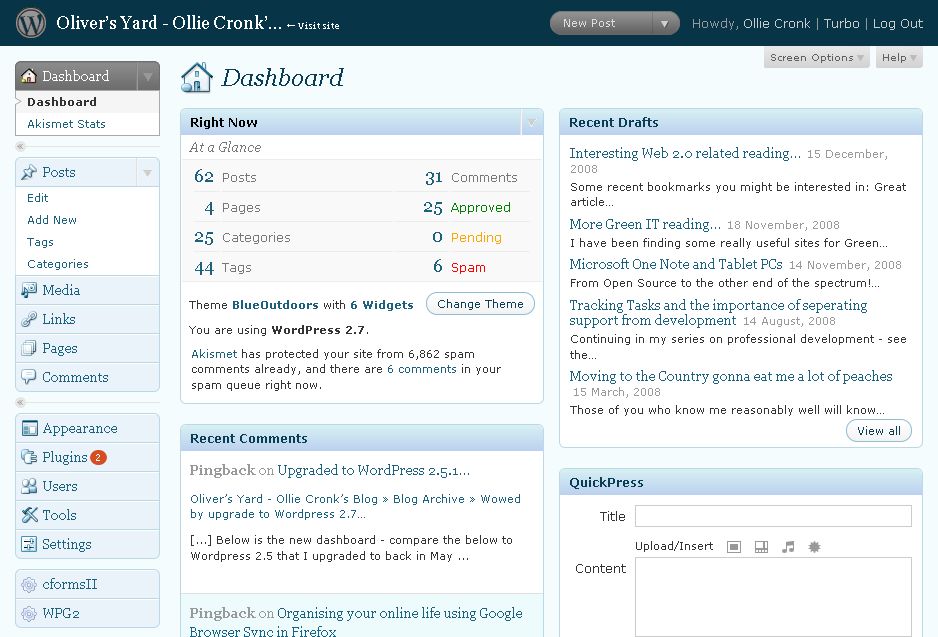
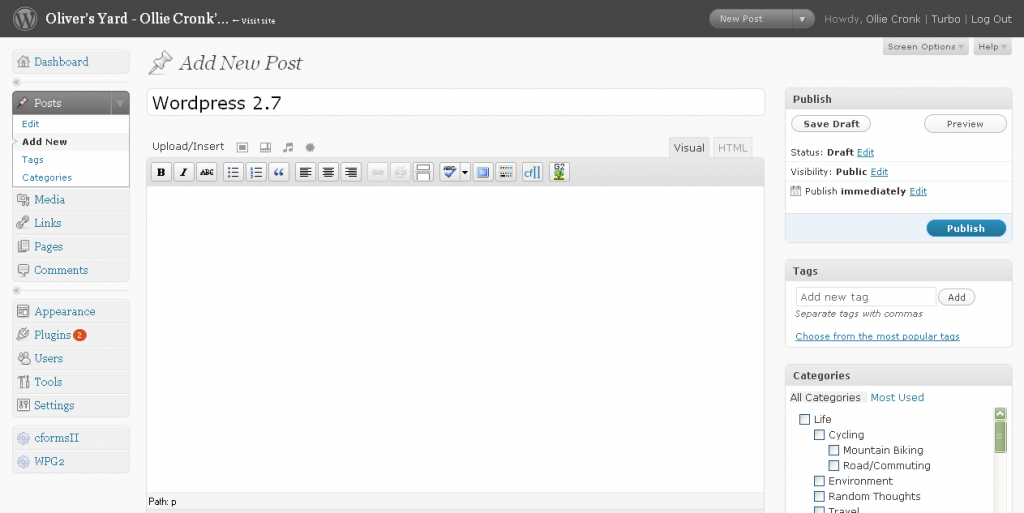
Have just upgraded to the latest and greatest Wordpress and was shocked as it has wowed me again in terms of user interface. The pace of improvement of this Open Source product is incredible. Just as I think wouldn’t it be good if… they’ve done it in the next release (and improved stability / fixed bugs). They’ve introduced a turbo button which makes use of Google Gears (the offline/browser enchancement) and added more time saving shortcuts and a better post writing interface (particularly for re-using existing tags on new posts – this UI for tagging taxonomy might have to be borrowed on some of my projects…) Read their blog post here for more info on features (includes a video). Below is the new dashboard – compare the below to Wordpress 2.5 that I upgraded to back in May 08
The new dashboard is below – it now has dragable “modules”
Trouble is it now makes me want to upgrade the design of my blog – but I know I have way more important things to do with my time before I faff with that again!
December 14, 2008
Filed Under (Technology, Web Development) by Ollie Cronk on 14-12-2008
Will write more once I’ve tried the IE8 beta out but more it would seem that it has (in classic Microsoft style) “borrowed” quite a few features from elsewhere – including some of the stability enhancements that Chrome has introduced…
November 18, 2008
Filed Under (Technology, Web Development) by Ollie Cronk on 18-11-2008
LinkedIn has finally launched its applications area, clearly this has been in germination for some time. Shame most of the ones I’ve tried are some what buggy – hopefully that will improve over time. Would be interested to know how your mileage with them goes… Last time I looked the apps platform was a closed beta – will have to check and see if thats changed. Post on their blog about it here: http://blog.linkedin.com/blog/
November 14, 2008
Filed Under (Open Source, Web Development) by Ollie Cronk on 14-11-2008
Alfresco’s features cover:
Its not that often (although admitedly it is now getting more common) you find an Open Source product that is strong on features / usability and is technically strong. The reason I say it is technical strong is due to the way it embraces and leverages Open Standards and Open Source Java components (Such as Hibernate etc – which good PHP frameworks have borrowed heavily from recently). One of Alfresco’s people writes an interesting blog on the Business/Politics of Open Source: http://news.cnet.com/openroad/ Another Interesting Alfresco blogger is John Newton: http://newton.typepad.com/content/ He has an article on CMIS (Content Management Interoperability Services) which sounds fantastic. Look forward to learning (and blogging) more about Alfresco if I get the opportunity…
October 24, 2008
Filed Under (Open Source, PHP, Technology, Web Development, Zend Framework) by Ollie Cronk on 24-10-2008
Previously we had a static HTML Intranet which wasn’t really serving the needs of the business as well as it could. The new site is based on the AEA Framework – which I’ve blogged about a bit before. Essentially an extension of the Zend Framework glueing Silverstripe and other 3rd party components together with a single sign on approach (in this case we are also using LDAP to do logins from our current Novell infrastructure). We built on our HTML content crawler tool to hoover in the static HTML into the Content Management System. Over time we will leverage the framework to create more efficient web 2.0 style business processes and work with PPC to combine it with other off the shelf tools that they specialise in; and hopefully push it globally across the group… I’ve also had some exciting news this week which I will share when I can. All exciting stuff!
August 30, 2008
* Uninstall Firefox Voila – you can install extensions again (like the brilliant FireBug) This also works for Linux (had a similar issue at home with the Latest version of Ubuntu).
July 21, 2008
Warning! Techy post – if your not into Web development you’ll want to skip this one… I’ve been wanting to try out Zend Core (Zend’s standard PHP stack / extension or “Reliable PHP made easy”) for a while but as Ubuntu isn’t officially supported I’ve held off. A problem with some code running on the Ubuntu version of PHP 5 forced my hand – I discovered that its actually not that hard to get ZC up and running on Ubuntu. Thought I’d share in case this is helpful to anyone…
PHP5 Module The ZC installer will have probably left your Apache configured with 2 LoadModule php5_module entries (one in /etc/apache2/apache2.conf – thanks to ZC and the other Ubuntu one in /etc/apache2/mods-enabled/php5.load). So you can either do a sudo a2dismod php5 to remove the Ubuntu one or modify the Ubuntu one to the following: LoadModule php5_module /usr/local/Zend/Core/modules/apache22/libphp5.so In fact you can be cunning here by commenting out the Ubuntu PHP5 extension and adding the ZC one in this file – allowing you to effectively switch between the 2 different extensions should you need to.
MySQL extension – if you’re using MySQL then you’ll need to watch out for the fact that the bundled MySQL extensions look for the MySQL socket file in /tmp/mysql.sock rather than the Debian / Ubuntu location which is /var/run/mysqld/mysqld.sock In most cases changing in php.ini: mysql.default_socket =
Does the trick; but alas not in all cases it seems (eg MySQL PDO). Really hacky fix to this (please do let me know if you have something better – other than editing the socket in the /etc/my.cnf file) is to run a scheduled (using crontab) symlink of /var/run/mysqld/mysql.sock to /tmp/mysql.sock To do this run: sudo crontab -e 5 * * * * ln -s /var/run/mysqld/mysqld.sock /tmp/mysql.sock And for now that works for me. If you want a copy of some of the relevant config files / snippets (including the extra bit that ZC adds to the apache2.conf) then I have zipped them up for ease.
Zend Core itself looks like a good product – being able to access to php.ini options via web based tool is pretty useful, as is knowing you are working on a consistent & tested version of PHP. Its a shame MySQL doesn’t offer a similar free / unsupported version of their MySQL Enterprise in a similar way really… |